
Plantago major L.
|
It is commonly known as Lahuriya and belongs to the Plantaginaceae family. Whole plant particularly leaves are cooked as vegetable. Catechol, Catechin, Luteolin, Ferulic acid are some of the bioactive compounds present in this plant. Aqueous extracts of P. major inhibited the proliferation of various human leukemia, lymphoma and carcinoma cells. Mode of Consumption : Cooked |
| Plant Details | Agro-climatic Zone | Vernacular Names | Pictures |
| Scientific Name: Plantago major L. Family: Plantaginaceae Juss. Class: Magnoliopsida Order: Lamiales Genus: Plantago L. Fruiting Season: February to April Parts: Whole plant |
|
Assam : Singa Gach Bihar : Lahuriya,Luhuriya Delhi : Lahuriya,Luhuriya Haryana : Lahuriya,Luhuriya Jharkhand : Lahuriya,Luhuriya Madhya Pradesh : Lahuriya,Luhuriya Manipur : Lamkung Rajasthan : Lahuriya,Luhuriya Tamil Nadu : Ishappukol Vitai Uttar Pradesh : Lahuriya,Luhuriya Uttarakhand : Lahuriya,Luhuriya |
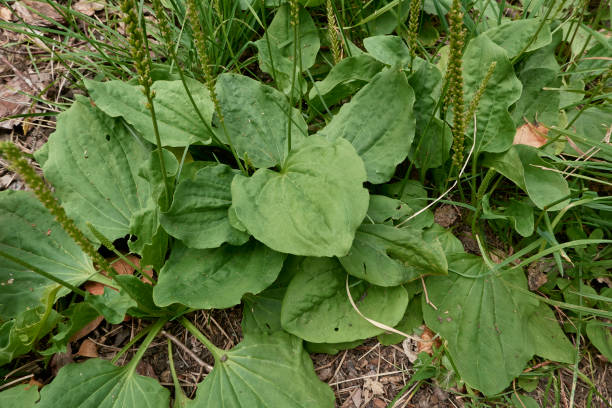 Plant |
| Compound/Extract | Activity | Mode of Action | Marker/References |
| Aqueous extract, Flavonoids, monoterpenoids, triterpenoids, iridoid glycosides and phenolic compounds | Immunnomodulatory | Aqueous extracts of P. major inhibited the proliferation of various human leukemia, lymphoma and carcinoma cells. The inhibitory effect (IC50) on K562, U937, P3HR1, HL-60 and CCRF-CEM cells was in the range 218 to 308 µg/ml. Hot water extracts of P. major possessed dual effects of immunomodulatory activity on human mononuclear cells proliferation and IFN-γ production. The water-soluble compounds viz. Aucubin, Chlorogenic acid, Ferulic acid, p-Coumaric acid and Vanillic acid, enhanced the activity of human lymphocyte proliferation and secretion of IFN-γ. Water insoluble Baicalein and Baicalin showed an enhancement of the human peripheral blood mononuclear cells (PBMC). Oleanolic acid and Ursolic acid exhibited a strong stimulation of IFN-γ secretion. Linalool, a monoterpenoid, showed a similar immunomodulatory activity as the triterpenoids. | IFN-γ[4] |
| Endotoxin-free methanol extract | Immunoenhancing | Endotoxin-free methanol extracts from its leaves, at doses of 50, 100, 250, and 500 µg/mL, were associated with 4.4 ± 1, 6 ± 1, 12 ± 0.4, and 18 ± 0.4-fold increases of nitric oxide (NO) production, and increased TNF-α production (621 ± 31, 721 ± 36, 727 ± 36, and 1056 ± 52 U/mL, respectively) by rat peritoneal macrophages, in the absence of IFN-γ or LPS. | [5] |
| Seed extract | Hepatoprotective | Extract of P. major seed, exhibits the hepatoprotective activity by which the levels of Alanine aminotransferase (ALT) and Aspartate aminotransferase (AST) showed reduction. | [6] |
| Major Class | Metabolites (Content of bioactives: mg/100g Fresh Weight) |
| Carboxylic Acid | Ferulic acid : 32.439 mg/100 g (leaves), 48.584 mg/100 g (seeds), Gallic acid: 4.8096 mg/100 g (leaves), 0.686 mg/100 g (seeds), Vanillic acid: 2.478 mg/100 g (leaves), 1.365 mg/100 g (seeds)[1] |
| Fatty acid | Linoleic acid: , Linolenic acid: , Myristic acid: , Oleic acid: , Palmitic acid: , Stearic acid: [3] |
| Flavonoid | Apigenin: , Baicalein: , Catechin : 15.924 mg/100 g (leaves), 3.684 mg/100 g (seeds), Chrisin: 0.0224 mg/100 g (leaves), 0.013 mg/100 g (seeds), Hispidulin: , Homoplantaginin: , Kaempferol: 0.825 mg/100 g (leaves), 0.347 mg/100 g (seeds), Luteolin : 10.079 mg/100 g (leaves), 7.107 mg/100 g (seeds), Luteolin-7-O-beta-glucoside: , Naringenin: 0.086 mg/100 g (leaves), 0.892 mg/100 g (seeds), Nepetin: , Plantaginin: , Quercetin: 2.089 mg/100 g (leaves), 1.563 mg/100 g (seeds), Rutin : 4.323 mg/100 g (leaves), 4.071 mg/100 g (seeds), Scutellarein: [3] |
| Heterocyclic Compound | Ellagic acid: 132.11 mg/100 g (leaves)[1] |
| Phenol | Catechol : 0.241 mg/100 g (leaves), 2.356 mg/100 g (seeds), Coumarin: 2.347 mg/100 g (leaves), 0.4387 mg/100 g (seeds)[1] |
| Phenolic acid | Caffeic acid: 8.164 mg/100 g (leaves), 9.832 mg/100 g (seeds)[1] |
| Phenolic compound | Colchicine: 25.026 mg/100 g (leaves), 1.828 mg/100 g (seeds), Syrengic: 4.158 mg/100 g (leaves), 3.074 mg/100 g (seeds)[1] |
| Polysaccharide | Glucomannan: , Plantaglucide: [3] |
| Quercetin | Hypersoide: 0.992 mg/100 g (leaves)[1] |
| Terpenoid | Ursolic acid: [2] |
| Triterpenoid | Oleanolic acid: [2] |
| Effect | Observation | DOI |
| Disease | Formulation | Reference | Author | TKDL |
| Information from Wealth of India | Reference |
|
CSIR(1982).The Wealth of India, Raw materials,Vol.-VIII ,P.147-148, New Delhi, India |
| 4.2, 4.2.1, 4.2.1.1, 4.2.1.3, 4.2.2.8, 4.2, 4.2.1, 4.2.1.1, 4.2.1.3, 4.2.2.8 |
| CSIR-North East Institute of Science and Technology, Jorhat-6, Assam, India
CSIR-Institute of Himalayan Bioresource Technology, Palampur-61,Himachal Pradesh, India |