
Ipomoea aquatica Forssk.
|
It is commonly known as Kalmi and is a leafy vegetable belonging to the family Convolvulaceae. It contains the bioactive markers like - Quercetin, Rutin, β-carotene, α-Tocopherol, Riboflavin, 7-O-β-D-glucopyranosyl-dihydroquercetin-3-O-α-D-glucopyranoside, and Nicotiflorin. Young leaves of I. aquatica are rich source of iron. The leaves of water spinach are nutritious to boost immune system. In vivo assay revealed the reduction of oxidative impairment due to administration of aqueous leaf extract (100 mg/kg, p.o.) against doxorubicin (3 mg/kg, i.p.) in the liver tissue of Wistar rats. Mode of Consumption : Sauteed, Fried and boiled |
| Plant Details | Agro-climatic Zone | Vernacular Names | Pictures |
| Scientific Name: Ipomoea aquatica Forssk. Family: Convolvulaceae Juss. Class: Magnoliopsida Order: Solanales Genus: Ipomoea L. Fruiting Season: April-June Parts: Leaves, Tender shoots |
|
Andhra Pradesh : Tutukura, Tigabaccali Assam : Kolmou, Pani Kolmu, Mandemaigong, Kaoasang, Dine thamunglai Goa : Takasi vel Gujarat : Nalanibhaji Karnataka : Neeru Bili gadde hambu, Nerru hambu Kerala : Ballel, Kozhuppa Maharashtra : Nalichi-bhaji, Nadishaka Manipur : Kolamni Odisha : Kalama saga Punjab : Ganthian, Nali, Nari Tamil Nadu : Sarkaravilli, Nali, Nalikam, Vallai, Vallai-k-kirai, Variparni, Vellaikeerai Uttar Pradesh : Kalmisag, Karmi, Patuasag West Bengal : Kalmisak |
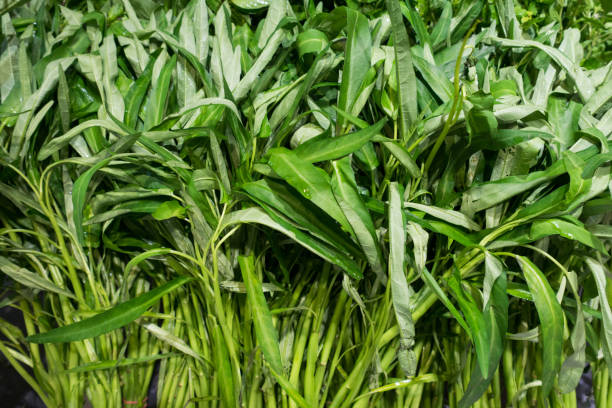 Tender shoots |
| Compound/Extract | Activity | Mode of Action | Marker/References |
| Aqueous extract of leaf | Hepatoprotective | Aqueous extract of leaf (400 mg/ml) prevented the Dox-induced increase in ROS, redox imbalance, and activation of mitogen activated protein kinases (MAPK) and intrinsic pathway of apoptosis in hepatocytes. In vivo assay, revealed administration of aqueous extract of leaf (100 mg/kg, p.o.) against Doxorubicin (3 mg/kg, i.p.) reduced the oxidative impairment, DNA fragmentation, ATP formation, and upregulated the mitochondrial co-enzymes Qs in the liver tissues of Wistar rats. | MAPK and ROS[4] |
| Boiled plant extract | Hypoglycemic | Boiled plant extract exerts an oral hypoglycaemic effect in healthy, male, Wistar rats. Significant reduction in the serum glucose concentrations was also observed. | [5] |
| Major Class | Metabolites (Content of bioactives: mg/100g Fresh Weight) |
| Carotenoid | Lutein: , β- Carotene: [1] |
| Flavanoid | Kaempferol-3-O-glucoside: , Luteolin: [1] |
| Flavonoid | Apigenin: , Mycertin: , Quercetin: , Rutin : [3] |
| Flavonol | Quercetin 3-O-glucoside: , Quercetin-3-O-rutinoside: [3] |
| Flavonol glycoside | 7-O-β-D-glucopyranosyl-dihydroquercetin-3-O-α-D-glucopyranoside: [2] |
| Flavonols | Isorhamnetin-3-O-rutinoside: [3] |
| Phenol | Kaempferol-3-O-rutinoside: , Nicotiflorin: [3] |
| Terpene | Cryptoxanthin: , Neoxanthin: , Violaxanthin: [1] |
| Terpenoid | Lutein epoxide: [1] |
| Vitamin | Ascorbic acid: , Cyanocobalamin: , Niacin: , Phylloquinone: , Pyridoxine: , Riboflavin: , Thiamine: , α-Tocopherol: [4] |
| Effect | Observation | DOI |
| Disease | Formulation | Reference | Author | TKDL |
| Information from Wealth of India | Reference |
|
CSIR(1985).The Wealth of India, Raw materials,Vol.-V ,P.237-238, New Delhi, India |
| 4.2, 4.2.1, 4.2.1.1, 4.2.1.2, 4.2.1.3, 4.2.2, 4.2.2.8 |
| CSIR-North East Institute of Science and Technology, Jorhat-6, Assam, India
CSIR-Institute of Himalayan Bioresource Technology, Palampur-61,Himachal Pradesh, India |